
BhaktiSanctum
Hariharaputra, the lord of Sabarimala
Shri Ayyappa
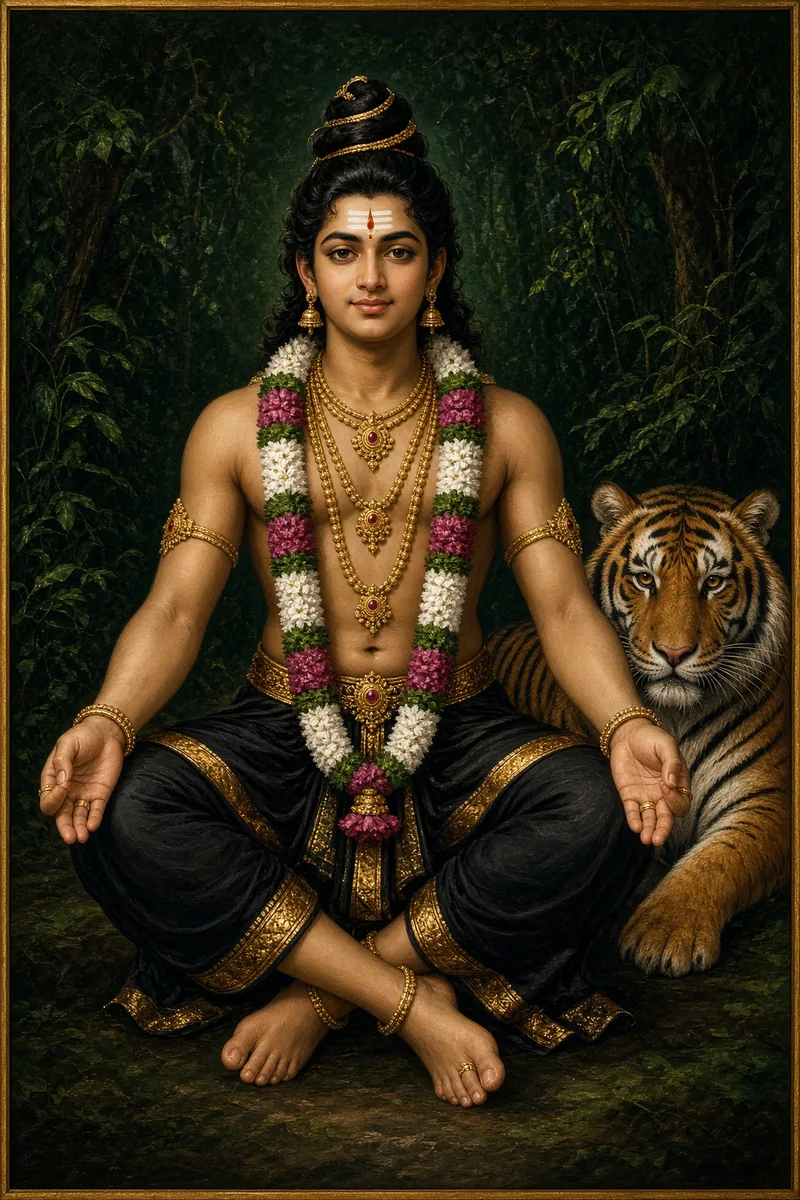
Shri Ayyappa is the lord who asks the pilgrim to become simple before climbing.
Katha
The tradition places his birth at the meeting of Shiva and Vishnu's mohini form, and his seat on a forest hill. Men who climb carry a burden and a shared name, Swami. The irumudi on the head is an offering, not a performance. Women of menstruating age have been the subject of a painful public quarrel. This shrine will not sneer at either the temple's rule or the devotee's pain. It asks for reverence, not for a slogan.
Swaroop and meaning
The climb is the puja. A darshan bought without the change of life is only a view.
- Vahana
- The tiger is remembered in his legend. The path is the real approach.
- Weapons and signs
- None raised in the seated yogic form.
- Consort and family
- The vow of the season is celibate. Malikappurathamma is worshipped at the foot of the path, not as a slight. Called the son of Bhagwan Shri Shiva and of Shri Vishnu as Mohini. That is the tradition's theology. Speak it with respect for both.
- Colour
- Black and saffron of the pilgrims
- Flower
- Forest flowers
- Vrat
- The forty-one days belong to those who have taken them. Do not imitate the austerity if you are ill, pregnant, or a child.
- Bhog
- A ghee-filled coconut · Camphor · A vow kept for the whole walk
- Temples and tirthas
- Sabarimala in Kerala is the great seat.
- Festivals
- Mandala puja and Makaravilakku, as the devaswom announces.
Mool mantra
स्वामिये शरणम् अय्यप्पा
Swamiye sharanam Ayyappa
Lord, I take refuge in Ayyappa.
Ayyappa yantra
A square, an eight-petal lotus, a bindu. The mantra is Swamiye Sharanam Ayyappa, complete, in the mantra hall. The installation is the vow itself, not a drawing sold as protection.
A plate is shown only when this deity's own geometry is in the yantra hall. Another deity's yantra is not borrowed.
See the yantra hallPuja vidhi
A household vidhi for Shri Ayyappa. It is complete without a priest. If your family has a stricter order, follow that. This is the common gentle form.
Samagri: A clean cloth for the seat, A lamp and oil or ghee, Incense, Water in a small vessel, Flowers, A ghee-filled coconut, Camphor, A vow kept for the whole walk.
Prepare the place
Sweep a small corner. Lay the cloth. Set a picture or a simple mark of Shri Ayyappa. Bathe, or at least wash face, hands, and feet. Sit facing east or north if the room allows.
Sankalpa
Say your name quietly, the weekday, and the intention: "I offer this puja to Shri Ayyappa for the welfare of this house." A sankalpa is a sentence, not a speech.
Light the lamp
Light the lamp and incense. Offer the flame first. If the air is close, keep the incense short. The lamp can stay.
Invocation
Join the palms. Say श्री अय्यप्पा and the mantra from the mantra hall (swamiye). Invite Shri Ayyappa as a guest, not as a force to be used.
Offerings
Offer water, then flowers, then the foods of this deity: A ghee-filled coconut, Camphor, A vow kept for the whole walk. What you will eat later, offer first. Do not offer anything you would not serve a person you respect.
Japa
Repeat the mantra 11, 28, or 108 times. Use the japa room of this app if you wish. One round done with attention is better than five done to finish.
Aarti and closing
Circle the lamp clockwise, three or seven times, if an aarti is in the mantra hall. Bow. Ask forgiveness for what was hurried. Share the offered food. Leave the seat as clean as you found it.
Copied stotras and names
- अय्यप्प अष्टोत्तर शत नाम स्तोत्रम्महाशास्ता महादेवो महादेवसुतोऽव्ययःNames · 30 verses
- अय्यप्प पञ्च रत्नम्लोकवीरं महापूज्यं सर्वरक्षाकरं विभुम्Stotras · 16 verses
- अय्यप्प शरणु घोषॐ श्री स्वामिने शरणमय्यप्पStotras · 152 verses
- अय्यप्प स्तोत्रम्अरुणोदयसङ्काशं नीलकुण्डलधारणम्Stotras · 11 verses
- श्री अय्यप्प अष्टोत्तर शत नामावलिॐ महाशास्त्रे नमःNames · 108 verses