
BhaktiSanctum
She who stills a cruel tongue
Maa Bagalamukhi
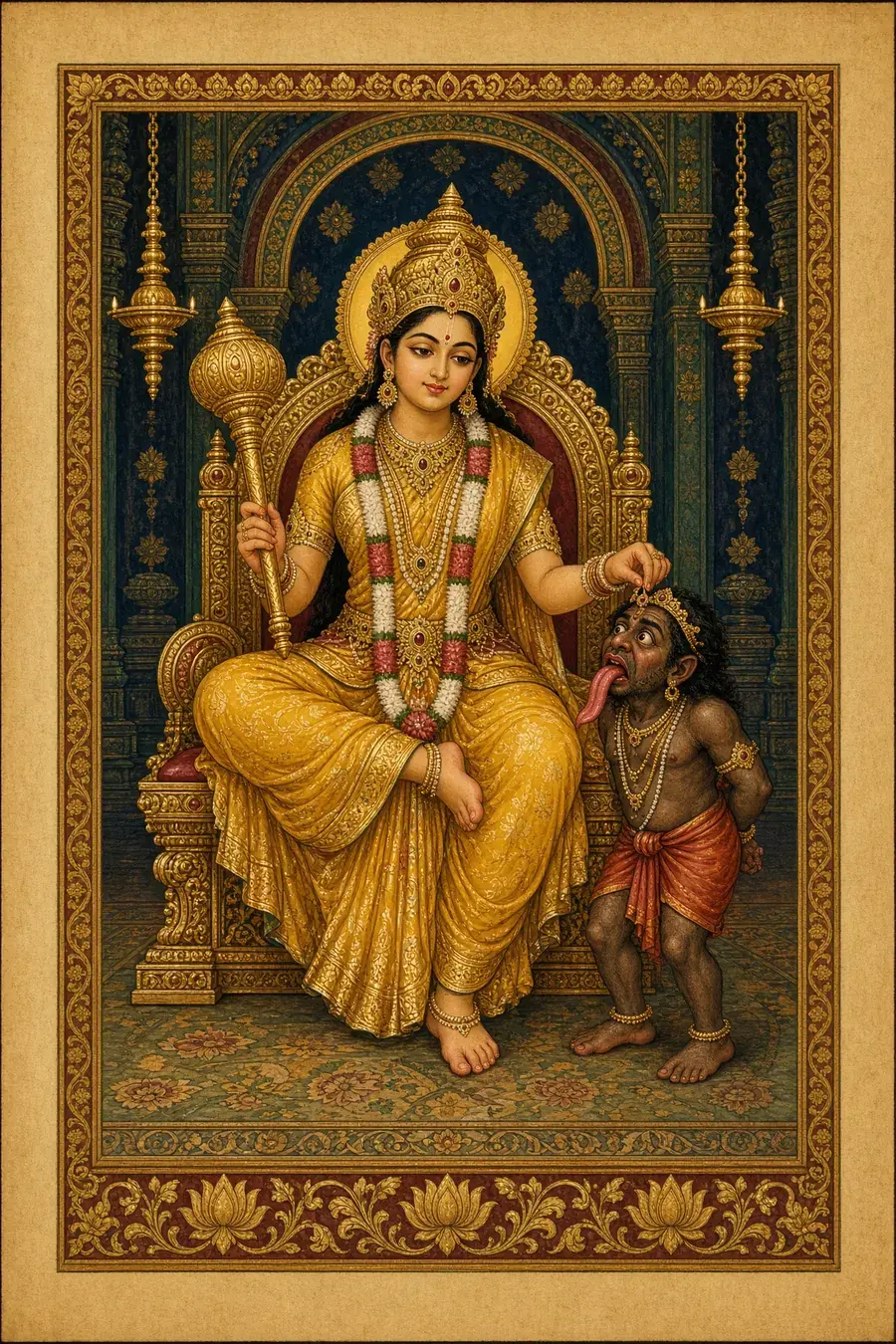
Maa Bagalamukhi is approached when a lie, a lawsuit, or a tongue has become a weapon.
Katha
Her yellow form holds a club and seizes the tongue of the one who speaks to destroy. Devotees have long prayed to her in danger from slander. The same prayer judges the devotee. If one is the slanderer, the club is not one's servant. Datia's Pitambara worship is famous and should be learned from that tradition's own discipline. This page gives the name, the colour, the warning, and nothing that pretends to be an initiation.
Swaroop and meaning
Ask that the cruel sentence stop. Begin with the one in your own mouth.
- Vahana
- A lotus seat, or a corpse in the fierce dhyana, which this household painting does not stage as horror.
- Weapons and signs
- A club, with which she holds the tongue of the demon of hostile speech.
- Consort and family
- A Mahavidya of the Mother. Among the ten Mahavidyas. Pitambara at Datia is a living seat of her worship.
- Colour
- Yellow
- Flower
- Marigold
- Vrat
- Thursday.
- Bhog
- Yellow flowers · Turmeric · A yellow cloth on the seat
- Temples and tirthas
- Pitambara Peeth, Datia, Madhya Pradesh, is widely approached.
- Festivals
- The days that peeth announces.
Mool mantra
ॐ ह्रीं बगलामुख्यै नमः
Om Hreem Bagalamukhyai Namah
Om. Salutation to Bagalamukhi.
Devi yantra
Her specialised yantra belongs to upasana under a teacher. This shrine does not draw the specialised diagram or the long beeja. Om Hreem Bagalamukhyai Namah is the open salutation. It is said for the stilling of cruel speech, including one's own. It is not a curse.
A plate is shown only when this deity's own geometry is in the yantra hall. Another deity's yantra is not borrowed.
See the yantra hallPuja vidhi
A household vidhi for Maa Bagalamukhi. It is complete without a priest. If your family has a stricter order, follow that. This is the common gentle form.
Samagri: A clean cloth for the seat, A lamp and oil or ghee, Incense, Water in a small vessel, Flowers, Yellow flowers, Turmeric, A yellow cloth on the seat.
Prepare the place
Sweep a small corner. Lay the cloth. Set a picture or a simple mark of Maa Bagalamukhi. Bathe, or at least wash face, hands, and feet. Sit facing east or north if the room allows.
Sankalpa
Say your name quietly, the weekday, and the intention: "I offer this puja to Maa Bagalamukhi for the welfare of this house." A sankalpa is a sentence, not a speech.
Light the lamp
Light the lamp and incense. Offer the flame first. If the air is close, keep the incense short. The lamp can stay.
Invocation
Join the palms. Say माँ बगलामुखी and the mantra from the mantra hall (om bagalamukhyai). Invite Maa Bagalamukhi as a guest, not as a force to be used.
Offerings
Offer water, then flowers, then the foods of this deity: Yellow flowers, Turmeric, A yellow cloth on the seat. What you will eat later, offer first. Do not offer anything you would not serve a person you respect.
Japa
Repeat the mantra 11, 28, or 108 times. Use the japa room of this app if you wish. One round done with attention is better than five done to finish.
Aarti and closing
Circle the lamp clockwise, three or seven times, if an aarti is in the mantra hall. Bow. Ask forgiveness for what was hurried. Share the offered food. Leave the seat as clean as you found it.
Copied stotras and names
- श्री बगलामुखी माता जी की आरतीश्री बगलामुखी माता जी की आरतीAartis · 11 verses
- बगलामुखी माता चालीसासिर नवाइ बगलामुखी, लिखूँ चालीसा आजChalisas · 46 verses
- बगलामुखी चालीसाबगलामुखी चालीसाChalisas · 46 verses
- श्री बगला प्रत्यङ्गिरा कवचम्श्री बगला प्रत्यङ्गिरा कवचम्Kavach · 26 verses
- श्री बगलामुखी अष्टोत्तर शत नामावलिःॐ बगलायै नमःNames · 114 verses
- श्री बगलामुखी अष्टोत्तर शत नामा स्तोत्रंभगवन् देवदेवेश सृष्टिस्थितिलयेश्वरNames · 48 verses
- श्री बगलामुखी दशनामात्मक स्तोत्रम्(श्रीरुद्रयामले)Stotras · 7 verses
- श्री बगलामुखी हृदयम्(श्रीसिद्धेश्वरतन्त्रे उत्तरखण्डे)Stotras · 111 verses
- श्री बगलामुखी कवचंकैलासाचलमध्यगं पुरवहं शान्तं त्रिनेत्रं शिवंKavach · 129 verses
- श्री बगलापञ्जरन्यासस्तोत्रम्बगला पूर्वतो रक्षेद् आग्नेय्यां च गदाधरीStotras · 11 verses
- श्री बगलामुखी ध्यानम्श्री बगलामुखी ध्यानम्Stotras · 12 verses
- श्री बगलामुखी (पीताम्बरी) सहस्रनामावलीश्री बगलामुखी (पीताम्बरी) सहस्रनामावलीNames · 1011 verses
- श्री बगलामुखी शत्रुविनाशक कवचम्श्री बगलामुखी शत्रुविनाशक कवचम्Kavach · 25 verses
- श्री बगलामुखी स्तवराजःवन्दे सकलसन्देहदावपावकमीश्वरम्Stotras · 96 verses
- श्री बगलामुखी स्तोत्रम् २(श्रीरुद्रयामलान्तर्गतम्)Stotras · 125 verses
- श्री बगलामुखी स्तोत्रम्श्री बगलामुखी स्तोत्रम्Stotras · 2 verses
- श्रीबगलाष्टोत्तरशतनामस्तोत्रम्श्रीदेव् युवाचNames · 42 verses
- श्रीबगलाष्टोत्तरशतनामस्तोत्रम्ॐ ब्रह्मास्त्ररूपिणी देवी माता श्रीबगलामुखीNames · 40 verses
- श्रीबगलाष्टोत्तरशतनामावलिःश्रीबगलाष्टोत्तरशतनामावलिःNames · 47 verses
- श्रीबगलाष्टोत्तरशतनामावलिःश्रीबगलाष्टोत्तरशतनामावलिःNames · 117 verses