
BhaktiSanctum
The one who gave her own head
Maa Chhinnamasta
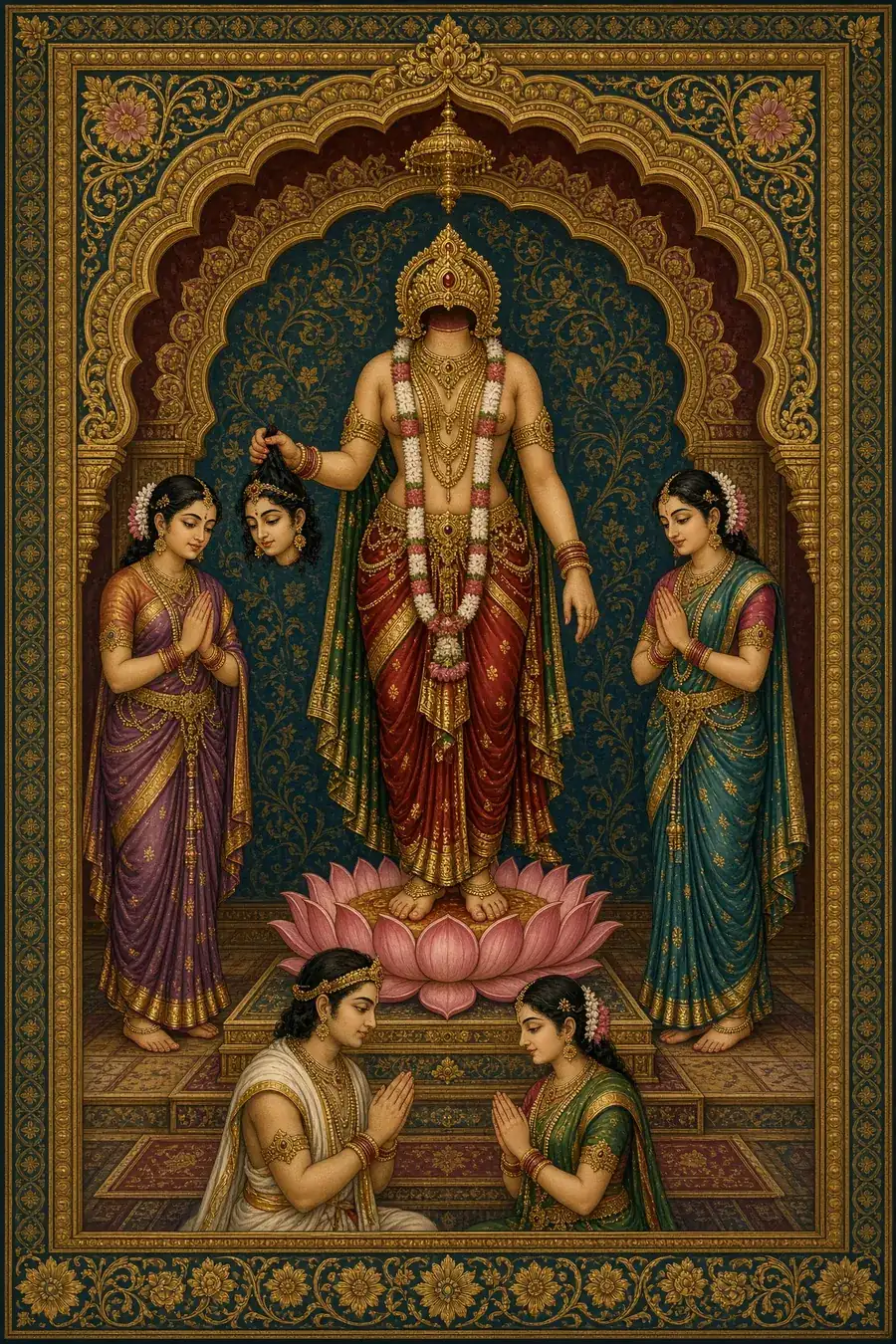
Maa Chhinnamasta is the Mahavidya of radical offering: the head, which is pride, given away so that life can go on.
Katha
The classical image is severe. She has cut off her own head, two attendants drink, and she stands on the couple whose union is the world continuing. Read as theology, it says that ego is the only blood the Mother asks, and that life feeds life. Read as violence, it has been failed. This sanctum's painting keeps the severed head, the full body, the attendants, and clothes the scene so a family may open the page. The mantra here is the name. It is not an invitation to harm the body. Ever.
Swaroop and meaning
Self-offering is the meaning. Self-destruction is the counterfeit.
- Vahana
- The classical dhyana stands her upon Kama and Rati. The painting in this shrine clothes that teaching and keeps every figure whole and decent for a home.
- Weapons and signs
- A sword, and her own severed head held up. The three streams are read as the giving of life, not as a taste for blood.
- Consort and family
- A Mahavidya. The couple beneath her, in the texts, are life continuing. Among the ten Mahavidyas. Dakini and Varnini are the two attendants of the classical image.
- Colour
- Red and gold
- Flower
- Red
- Vrat
- No harsh fast. This form is not kept to shock a child.
- Bhog
- Red flowers · A lamp · Food given to someone hungry
- Temples and tirthas
- A few Shakta temples, and the careful household that knows the story.
- Festivals
- Follow the local tithi.
Mool mantra
ॐ छिन्नमस्तायै नमः
Om Chhinnamastayai Namah
Om. Salutation to Chhinnamasta.
Devi yantra
Lineage yantras of Chhinnamasta are transmitted by teachers. This shrine does not draw a guessed one. The Devi yantra and the salutation are the open door.
A plate is shown only when this deity's own geometry is in the yantra hall. Another deity's yantra is not borrowed.
See the yantra hallPuja vidhi
A household vidhi for Maa Chhinnamasta. It is complete without a priest. If your family has a stricter order, follow that. This is the common gentle form.
Samagri: A clean cloth for the seat, A lamp and oil or ghee, Incense, Water in a small vessel, Flowers, Red flowers, A lamp, Food given to someone hungry.
Prepare the place
Sweep a small corner. Lay the cloth. Set a picture or a simple mark of Maa Chhinnamasta. Bathe, or at least wash face, hands, and feet. Sit facing east or north if the room allows.
Sankalpa
Say your name quietly, the weekday, and the intention: "I offer this puja to Maa Chhinnamasta for the welfare of this house." A sankalpa is a sentence, not a speech.
Light the lamp
Light the lamp and incense. Offer the flame first. If the air is close, keep the incense short. The lamp can stay.
Invocation
Join the palms. Say माँ छिन्नमस्ता and the mantra from the mantra hall (om chhinnamastayai). Invite Maa Chhinnamasta as a guest, not as a force to be used.
Offerings
Offer water, then flowers, then the foods of this deity: Red flowers, A lamp, Food given to someone hungry. What you will eat later, offer first. Do not offer anything you would not serve a person you respect.
Japa
Repeat the mantra 11, 28, or 108 times. Use the japa room of this app if you wish. One round done with attention is better than five done to finish.
Aarti and closing
Circle the lamp clockwise, three or seven times, if an aarti is in the mantra hall. Bow. Ask forgiveness for what was hurried. Share the offered food. Leave the seat as clean as you found it.
Copied stotras and names
- छिन्नमस्ता चालीसाछिन्नमस्ता चालीसाChalisas · 45 verses
- छिन्नमस्ताध्यानम्छिन्नमस्ताध्यानम्Stotras · 53 verses
- श्री छिन्नमस्ता सहस्रनाम स्तोत्रम्श्री छिन्नमस्ता सहस्रनाम स्तोत्रम्Names · 405 verses
- श्रीछिन्नमस्तासहस्रनामावलिःश्रीछिन्नमस्तासहस्रनामावलिःNames · 1021 verses
- श्री छिन्नमस्ता अष्टोत्तर शत नामावलिःॐ छिन्नमस्तायै नमःNames · 108 verses
- श्री छिन्नमस्ता अष्टोत्तर शत नामा स्तोत्रंनाम्नां सहस्रं परमं छिन्नमस्ताप्रियं शुभम्Names · 51 verses
- श्री छिन्नमस्ता कवचम्श्री छिन्नमस्ता कवचम्Kavach · 77 verses
- Chin Nama Sta Sahasranama Stotramछिन्नमस्तासहस्रनामस्तोत्रम्Names · 196 verses