
BhaktiSanctum
The widow goddess, smoke and truth
Maa Dhumavati
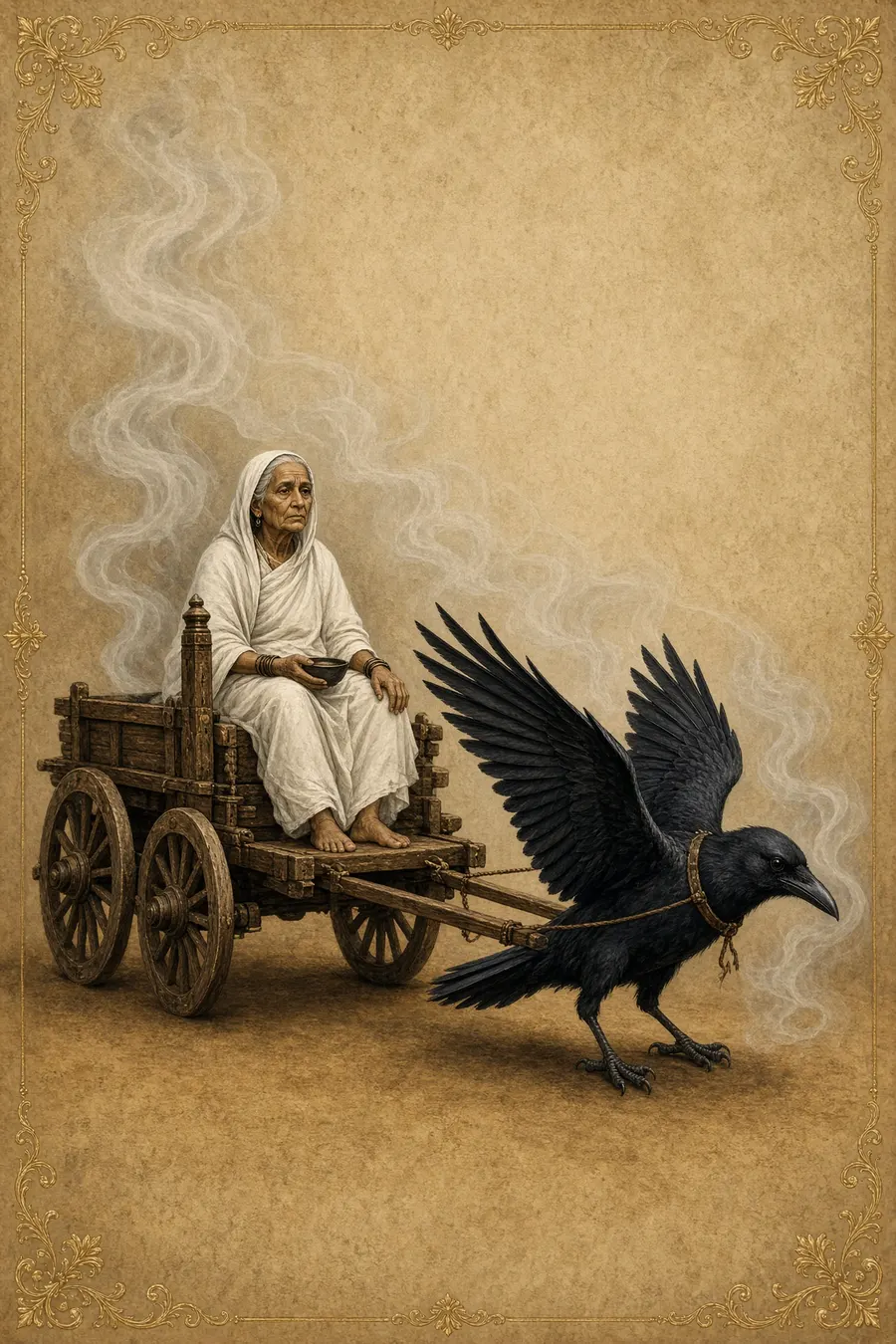
Maa Dhumavati is the wisdom that remains when ornament, spouse, and comfort have gone.
Katha
The stories say she arose as smoke, or as the Mother in the form of a widow when existence itself was swallowed and given back. Widows in India have suffered from cruel custom. This goddess is not a licence for that cruelty. She is a rebuke to it: the divine does not leave the woman the world sets aside. Her crow eats what others refuse. Her worship is a quiet lamp and a meal shared with someone lonely.
Swaroop and meaning
If worship cannot look at loss without disgust, it is still only a festival.
- Vahana
- A crow.
- Weapons and signs
- None that flatter. A winnowing basket appears in some dhyanas. Her weapon is disillusionment.
- Consort and family
- In the telling she is the Mother as widow. She is not mocked for that, and not used as a curse-form. Among the ten Mahavidyas.
- Colour
- Smoke-grey
- Flower
- Any simple flower. Do not make a show.
- Vrat
- Saturday, with food given away. The ill do not fast.
- Bhog
- Black sesame · A simple lamp · Food given to an elder who is alone
- Temples and tirthas
- A few Shakta houses keep her. She does not need a palace.
- Festivals
- No separate festival day is kept here.
Mool mantra
ॐ धूमावत्यै नमः
Om Dhumavatyai Namah
Om. Salutation to Dhumavati.
Devi yantra
The Devi yantra drawn here is a downward triangle in a lotus, with her own mantra in the heart. It is sat for contemplation after a bath and a lamp. It is not used to bind another person.
A plate is shown only when this deity's own geometry is in the yantra hall. Another deity's yantra is not borrowed.
See the yantra hallPuja vidhi
A household vidhi for Maa Dhumavati. It is complete without a priest. If your family has a stricter order, follow that. This is the common gentle form.
Samagri: A clean cloth for the seat, A lamp and oil or ghee, Incense, Water in a small vessel, Flowers, Black sesame, A simple lamp, Food given to an elder who is alone.
Prepare the place
Sweep a small corner. Lay the cloth. Set a picture or a simple mark of Maa Dhumavati. Bathe, or at least wash face, hands, and feet. Sit facing east or north if the room allows.
Sankalpa
Say your name quietly, the weekday, and the intention: "I offer this puja to Maa Dhumavati for the welfare of this house." A sankalpa is a sentence, not a speech.
Light the lamp
Light the lamp and incense. Offer the flame first. If the air is close, keep the incense short. The lamp can stay.
Invocation
Join the palms. Say माँ धूमावती and the mantra from the mantra hall (om dhumavatyai). Invite Maa Dhumavati as a guest, not as a force to be used.
Offerings
Offer water, then flowers, then the foods of this deity: Black sesame, A simple lamp, Food given to an elder who is alone. What you will eat later, offer first. Do not offer anything you would not serve a person you respect.
Japa
Repeat the mantra 11, 28, or 108 times. Use the japa room of this app if you wish. One round done with attention is better than five done to finish.
Aarti and closing
Circle the lamp clockwise, three or seven times, if an aarti is in the mantra hall. Bow. Ask forgiveness for what was hurried. Share the offered food. Leave the seat as clean as you found it.
Copied stotras and names
- धूमावती ध्यानम् - विवर्णा चञ्चला रुष्टा दिर्घा च मलिनाम्बराविवर्णा चञ्चला रुष्टा दिर्घा च मलिनाम्बराStotras · 6 verses
- श्री धूमावती अष्टोत्तर शत नामावलिःॐ धूमावत्यै नमःNames · 108 verses
- श्री धूमावती अष्टोत्तर शत नामा स्तोत्रंॐ धूमावती धूम्रवर्णा धूम्रपानपरायणाNames · 38 verses
- श्री धूमावती कवचम्श्रीपार्वत् युवाचKavach · 28 verses