
BhaktiSanctum
Speech that the proud called impure
Maa Matangi
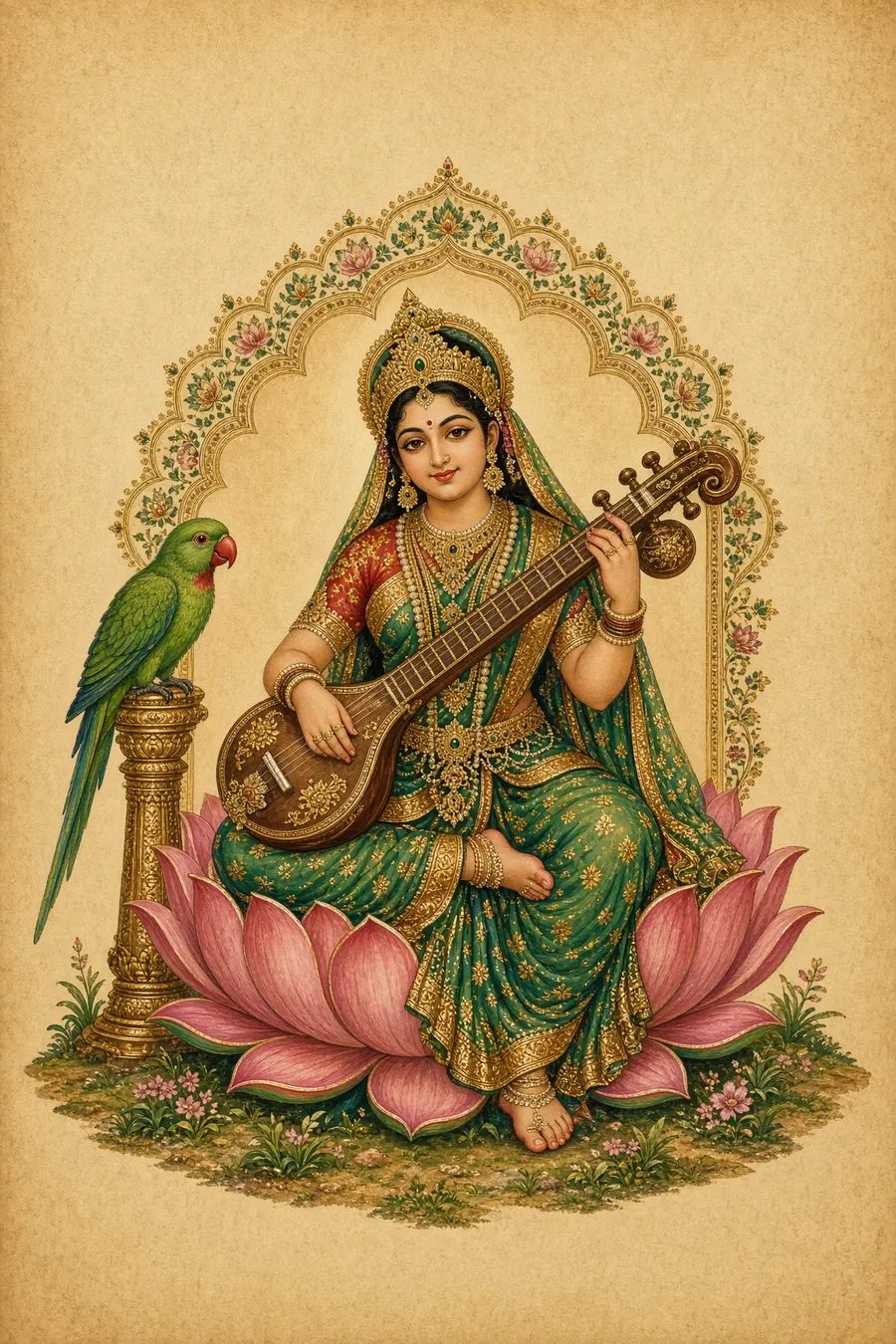
Maa Matangi is the Mahavidya of utterance, especially the utterance that orthodox pride wanted to keep outside.
Katha
One telling says she accepted food that had been tasted, and so broke the idea that God stays only in the untouched. Another joins her to the daughter of the sage Matanga. The veena says she is learning. The fierce signs say learning that has never crossed a boundary is still afraid. She is not an excuse for contempt toward any caste or any guest. She is the opposite. The one the room will not seat is, in this theology, closest to the music.
Swaroop and meaning
If your worship needs someone else to be unclean, it is not her worship.
- Vahana
- A parrot or a swan in many pictures. The veena is more important than the vehicle.
- Weapons and signs
- A sword and a noose in some dhyanas, and always the veena of speech.
- Consort and family
- A Mahavidya. She is the outsider who is nonetheless the goddess of music and learning. Among the ten Mahavidyas. She is close, in meaning, to Maa Saraswati, and she is not polite about pollution.
- Colour
- Emerald
- Flower
- Any flower offered with a song
- Vrat
- Wednesday.
- Bhog
- A little food that has been tasted, if one has been taught the Ucchishta rite. Otherwise a clean plate of fruit and a song.
- Temples and tirthas
- Shakta worship.
- Festivals
- No separate festival day is kept here.
Mool mantra
ॐ ऐं मातङ्ग्यै नमः
Om Aim Matangyai Namah
Om. Salutation to Matangi, with the seed-sound of speech.
Devi yantra
The Devi yantra drawn here is a downward triangle in a lotus, with her own mantra in the heart. It is sat for contemplation after a bath and a lamp. It is not used to bind another person.
A plate is shown only when this deity's own geometry is in the yantra hall. Another deity's yantra is not borrowed.
See the yantra hallPuja vidhi
A household vidhi for Maa Matangi. It is complete without a priest. If your family has a stricter order, follow that. This is the common gentle form.
Samagri: A clean cloth for the seat, A lamp and oil or ghee, Incense, Water in a small vessel, Flowers, A little food that has been tasted, if one has been taught the Ucchishta rite. Otherwise a clean plate of fruit and a song..
Prepare the place
Sweep a small corner. Lay the cloth. Set a picture or a simple mark of Maa Matangi. Bathe, or at least wash face, hands, and feet. Sit facing east or north if the room allows.
Sankalpa
Say your name quietly, the weekday, and the intention: "I offer this puja to Maa Matangi for the welfare of this house." A sankalpa is a sentence, not a speech.
Light the lamp
Light the lamp and incense. Offer the flame first. If the air is close, keep the incense short. The lamp can stay.
Invocation
Join the palms. Say माँ मातङ्गी and the mantra from the mantra hall (om matangyai). Invite Maa Matangi as a guest, not as a force to be used.
Offerings
Offer water, then flowers, then the foods of this deity: A little food that has been tasted, if one has been taught the Ucchishta rite. Otherwise a clean plate of fruit and a song.. What you will eat later, offer first. Do not offer anything you would not serve a person you respect.
Japa
Repeat the mantra 11, 28, or 108 times. Use the japa room of this app if you wish. One round done with attention is better than five done to finish.
Aarti and closing
Circle the lamp clockwise, three or seven times, if an aarti is in the mantra hall. Bow. Ask forgiveness for what was hurried. Share the offered food. Leave the seat as clean as you found it.
Copied stotras and names
- श्रीमातङ्ग्यष्टोत्तरशतनामस्तोत्रम्श्रीमातङ्ग्यष्टोत्तरशतनामस्तोत्रम्Names · 40 verses
- मातंगी ध्यानम् - श्यामांगीं शशिशेखरां त्रिनयनां रत्नसिंहासनस्थिताम्मातंगी ध्यानम् - श्यामांगीं शशिशेखरां त्रिनयनां रत्नसिंहासनस्थिताम्Stotras · 1 verse
- श्री मातङ्गी अष्टोत्तर शत नामावलिःॐ महामत्तमातङ्गिनीसिद्धिरूपायै नमःNames · 108 verses
- श्री मातङ्गी अष्टोत्तर शत नामा स्तोत्रंभगवन् श्रोतुमिच्छामि मातङ्ग्याः शतनामकम्Names · 78 verses
- श्रीमातङ्गीध्यानम्तालीदलेनार्पितकर्णभूषांStotras · 21 verses
- श्री मातङ्गी हृदयम्श्री मातङ्गी हृदयम्Stotras · 83 verses
- श्री मातङ्गी कवचम् (सुमुखी कवचम्)श्री मातङ्गी कवचम् (सुमुखी कवचम्)Kavach · 48 verses
- श्रीमातङ्गीसहस्रनामावलिःॐ सुमुख्यै नमःNames · 1001 verses
- श्री मातङ्गी स्तोत्र पुष्पाञ्जलिः (Sri Matangi Stotra Pushpanjali)श्री मातङ्गी स्तोत्र पुष्पाञ्जलिः (Sri Matangi Stotra Pushpanjali)Stotras · 61 verses
- श्री मातङ्गी स्तोत्रम् २श्री मातङ्गी स्तोत्रम् २Stotras · 35 verses
- उमासहाचार्य विरचितं श्री मातङ्गी स्तोत्रम् (आगमसार)उमासहाचार्य विरचितं श्री मातङ्गी स्तोत्रम् (आगमसार)Stotras · 273 verses
- श्री मातङ्गी स्तोत्रम् (एकजटा कल्पलतिका)श्री मातङ्गी स्तोत्रम् (एकजटा कल्पलतिका)Stotras · 21 verses
- श्रीमातङ्गी स्तुतिः (मातङ्ग ऋषि प्रणीत)श्रीमातङ्गी स्तुतिः (मातङ्ग ऋषि प्रणीत)Stotras · 172 verses
- श्रीमातङ्गीस्तुतिःश्रीमातङ्गीस्तुतिःStotras · 49 verses