
BhaktiSanctum
The plant who is a woman, and the woman who is a plant
Maa Tulsi
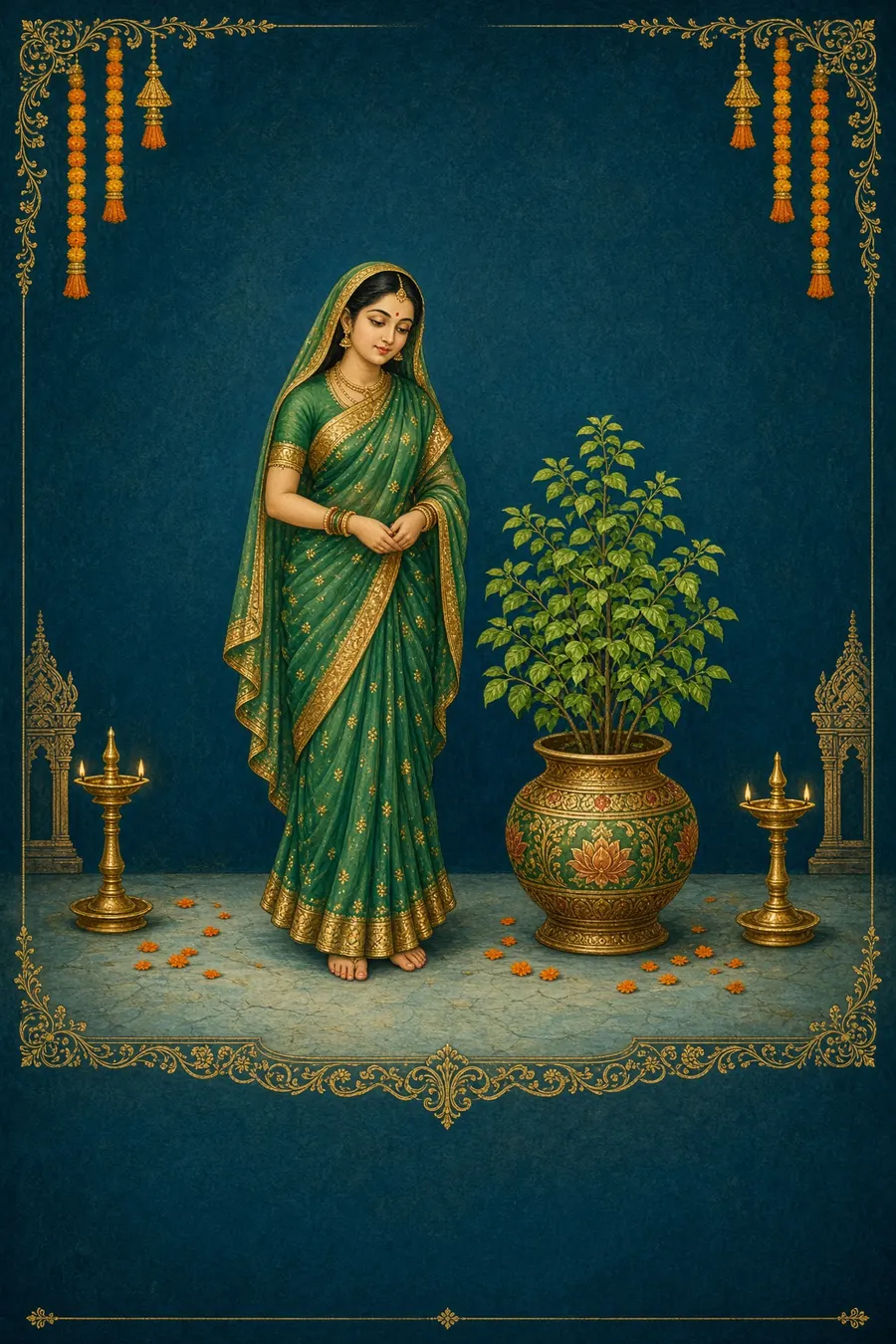
Maa Tulsi is the courtyard's goddess, a woman and a plant, without whom a Vaishnava house feels unfinished.
Katha
The Puranic story of her origin is stern, a tale of a woman wronged in a quarrel of gods and then honoured as the herb Shri Vishnu will not refuse. Whatever one makes of that telling, the practice is kind: water her, do not snap her for show, and in Kartika give her a lamp and a marriage to the Lord. The painting shows both bodies, woman and plant, so neither is forgotten.
Swaroop and meaning
The smallest shrine in India may be a pot. It still counts.
- Vahana
- None. The plant beside her is her other body.
- Weapons and signs
- None.
- Consort and family
- The tradition calls her dear to Shri Vishnu, and tells a hard story of her becoming the plant. Worshipped in the courtyard of Vaishnava houses.
- Colour
- Green
- Flower
- Her own leaves, offered only as the custom allows
- Vrat
- Kartika, when many houses light a lamp at her root. Do not pluck her roughly.
- Bhog
- Water at her root · A lamp at her feet · No plucking on the day you have set aside
- Temples and tirthas
- The courtyard. A few temples keep her as a goddess in her own right.
- Festivals
- Tulsi vivaha, at the end of Kartika, when she is married to a shaligrama or to Shri Krishna.
Mool mantra
ॐ तुलस्यै नमः
Om Tulasyai Namah
Om. Salutation to Tulsi.
The pot itself
The installed yantra is the tulsi pot, watered, lamp-lit in Kartika. Mantra Om Namo Narayanaya. No paper yantra replaces the living plant.
A plate is shown only when this deity's own geometry is in the yantra hall. Another deity's yantra is not borrowed.
See the yantra hallPuja vidhi
A household vidhi for Maa Tulsi. It is complete without a priest. If your family has a stricter order, follow that. This is the common gentle form.
Samagri: A clean cloth for the seat, A lamp and oil or ghee, Incense, Water in a small vessel, Flowers, Water at her root, A lamp at her feet, No plucking on the day you have set aside.
Prepare the place
Sweep a small corner. Lay the cloth. Set a picture or a simple mark of Maa Tulsi. Bathe, or at least wash face, hands, and feet. Sit facing east or north if the room allows.
Sankalpa
Say your name quietly, the weekday, and the intention: "I offer this puja to Maa Tulsi for the welfare of this house." A sankalpa is a sentence, not a speech.
Light the lamp
Light the lamp and incense. Offer the flame first. If the air is close, keep the incense short. The lamp can stay.
Invocation
Join the palms. Say माँ तुलसी and the mantra from the mantra hall (om tulasyai). Invite Maa Tulsi as a guest, not as a force to be used.
Offerings
Offer water, then flowers, then the foods of this deity: Water at her root, A lamp at her feet, No plucking on the day you have set aside. What you will eat later, offer first. Do not offer anything you would not serve a person you respect.
Japa
Repeat the mantra 11, 28, or 108 times. Use the japa room of this app if you wish. One round done with attention is better than five done to finish.
Aarti and closing
Circle the lamp clockwise, three or seven times, if an aarti is in the mantra hall. Bow. Ask forgiveness for what was hurried. Share the offered food. Leave the seat as clean as you found it.
Copied stotras and names
- श्री तुलसी जी की आरतीश्री तुलसी जी की आरतीAartis · 10 verses
- श्री तुळशीची आरतीजय देवी जय देवी जय माये तुळशीAartis · 7 verses
- श्री तुलसी चालीसाश्री तुलसी चालीसाChalisas · 49 verses
- श्री तुलसी जी की आरतीजय जय तुलसी माता, सब जग की सुख दाता, वर दाताAartis · 6 verses
- श्री तुलसी अष्टोत्तर शतनाम स्तोत्रम्ॐ तुलस्यै नमःNames · 109 verses
- तुलसी श्री सखीतुलसी श्री सखी शुभे पापहारिणि पुण्यदेStotras · 2 verses
- श्री तुलसी स्तोत्रम्जगद्धात्रि नमस्तुभ्यं विष्णोश्च प्रियवल्लभेStotras · 31 verses
- श्री तुलसी चालीसाश्री तुलसी चालीसाChalisas · 25 verses